Thursday, May 7, 2009

Picture #5


Group at swearing-in.

Swearing-In and Vacation at the Lake House

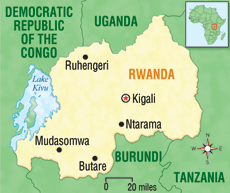
Sadly, we have left Butare and Pre-Service Training (PST) behind and are now full-on PCVs. Most PCVs are thrilled to be out of staging, but because we were so spoiled and surrounded by muzungus, it is hard for many of us to move beyond the honeymoon phase. It is time to deal with the reality of being on our own in a foreign land, with new jobs to do in a language that we only kind of sort of know the very basics of.

The swearing-in ceremony, held at the ambassador’s house (the ambassador from the United States of America to Rwanda, not to be confused with the ambassador from Rwanda to the United States of America), was high-class all the way, from mini quiches to the US seal on the cutlery and china. All sorts of Rwandan dignitaries were there, including the Minister of Education, and all manner of Rwandan press. Later that night, we were on Rwandan television in all three language formats: English, French, and Kinyarwanda. In fact, when I was in Kigali I was trying to buy a part for our gas stove in a hardware store in Kinyarwanda and the guy asked me if I was one of the “ones who are trying to learn Kinyarwanda and the Rwandan culture” because he had seen us on TV. The program included a speech by one of our own in English, a much-practiced speech by two of our group in Kinyarwanda (part of which was aired on TV) , and speeches by the Ambassador and Country Director. Honestly, as a true Peace Corps volunteer, I found the most exciting part of it all was the good food: mini pizzas, homemade cookies, and freshly squeezed juice. This was all followed by the requisite group photo session, in which, despite the million and one pictures, we failed to take a picture in which we were all looking at the camera (see picture.)

To celebrate our new status as official Peace Corps volunteers, the Peace Corps Rwanda staff put together a nice little outing for us to Lake Muhazi, a lake in the Eastern province of Rwanda. The house and property on the lake are actually all owned by the US Embassy so we were accompanied by four of the ten US Marines that guard the Embassy. The Marines had a tiny little blow-up motor boat that they used to take people wakeboarding on the lake. Talk about a scene that doesn’t belong on a lake in the middle of Rwanda, especially when to get to the lake you have to drive by huge demobilization and reintegration centers. The rest of the day was spent drinking Primus on the shore and throwing around a football (turns out, even in Rwanda, it is handy to have two brothers that force you to learn such things.)

Picture #4


A crossroads outside of Butare.

Bicycles and Brunch in Butare

On our last Sunday in Butare, a group of us went out to our favorite brunch spot- Hotel Ibis. Though Hotel Ibis has a storied past- it was built during Belgian colonial times and was once used by the interahamwe as headquarters- today’s Hotel Ibis is a muzungu hangout that provides the best people watching and breakfast in town. To be honest, I am sure that we would all be thrilled for any semi-American breakfast food, but the omelettes and French toast at Ibis really are fantastic. This particular Sunday morning, as we sat there remising about our eleven weeks in Butare, the Rwandan national cycling team road by. As the true triathlete that I am, I sat there and gawked, spinning my head as they went back and forth down the main street of Butare. Instead, I abandoned all attempts at following the conversation and imagined myself on my Cervelo following them over the hills of Rwanda. I suppose traversing the dirt roads on my Trek mountain bike will have to do. If riding the hills of Nepal doing aid work can help Chrissie Wellington become the triathlete she is today, just maybe it might do a little something for me too.

Wednesday, April 8, 2009

April Fool's Day, Dancing Wizards and All

At times, our training resembles a sleep away camp for 20-somethings, with our centralized living quarters, family-style meals, and communal bathrooms (not to mention ghost story nights.) However, this was never more true than when the April Fool’s jokes started with someone stealing the bell (really a piece of metal that we hit with rocks) that summons us to class each morning. The jokes continued with us switching classes before the teachers got there, though the joke was, in the end, on us, because the teachers just continued teaching class as though nothing was amiss. Our class was particularly into the April Fool’s jokes, so when one of our members went to the bathroom, we naturally hid her notebook in the rafters of our little classroom hut and her water bottle in the bush outside. Halfway through class, the gardener came along and started pruning the bush, completely oblivious to the water bottle, which remained hidden.

The day got even better when one of our language classes was dedicated to discussing dancing wizards…in Rwanda, there is a verb for “to be a dancing wizard in the night” (gucuragura). No April Fool’s joke. Apparently there are also dancing wizards in many villages- the teacher who explained all this to us said there were two in her village, but they both died (which begs the question, how does a wizard die?) I still don’t have the full story, but the wizards seem to dance outside people’s houses at night and then go home to their wives, where their wives must provide a hot bucket bath. Odd detail yes, but as a health volunteer I applaud the cleanliness of the wizards, even if it is after a full night of terrorizing the countryside.

Graduation Day

When you think of graduation, especially college graduation, in the United States, often one of the first images that comes to mind is that of large white tents with flocks of proud parents and robed graduates-to-be milling underneath. Well, this was surprisingly like the graduation here for the National University of Rwanda graduates. As the largest and more prestigious university in Rwanda, the graduation was quite the occasion, and from Thursday on (the graduation was on Friday) there was an air of excitement surrounding Butare. Seven of our language teachers, including my roommate, graduated, so we were invited to attend and take part in all the excitement. What was truly different about the graduation here was how excited the graduates here were to be graduating- the nonchalance of too-cool-for-school college graduates in the United States was nowhere to be seen.

A Presentation or an Earthquake?

I’ve experience a tornado, a hurricane, and many a blizzard back in the United States, but I had to travel all the way to Rwanda to experience (at least to my knowledge) my first earthquake. Per usual, I was on time to breakfast and sat down to the standard coffee and bread. Before I had even finished buttering my bread, there was a loud shaking, but I just assumed it was a big truck going by- only the California people knew what it was, and left the dining room immediately. Rumor has it the earthquake registered a 6.1 in Chyangugu, near the border with the Democratic Republic of Congo, but here in Butare I’m guessing (with my extensive earthquake experience) it was far less. BUT it was the largest since the earthquake here last year that killed several people- fortunately this one injured neither people nor buildings. For all you geography/geology buffs out there, the volcanoes along the DRC and Rwanda border were formed by seismic activity of tectonic plates in the region, so there may be more excitement in store for the volunteers place in the Western province.

After that bang (or, rather, quake) of a morning, came another first- my first health presentation in Kinyarwanda. The presentation was to an outreach group brought together by the nearby women’s center and actually took place in the same Catholic Church where my resource family goes to church. We (four of us) were scheduled for the very beginning of a full day on family planning and I was responsible for explaining the biology of HIV and AIDS to this group of young adults. Biology is a hard subject to explain even when you know the language and culture, so you can imagine the difficulty I had in explaining this subject in Kinyarwanda. When describing the immune system, for instance, I had to call it “the body’s way of fighting bad things.” Close, but not quite. Fortunately, the audience was very receptive to the muzungu butchering their language and explaining a concept that seems so divorced from the everyday reality of diseases like HIV and AIDS. After all four of us finished, we even had several questions, which we took as a good sign- Rwandan culture tends towards a reserved nature, so their confidence indicates that we may actually have gotten some of the information across. The presentation helped to reassure me that while communication and the community’s trust may be a struggle at first, it is indeed possible and I just might be able to achieve something once at site.