Monday, March 23, 2009

Picture #3


A monkey from the National Park.

Pizza for 60 and Miss America

After the sobering realities of my site visit and accompanying blog entry, I figured it was time for a more lighthearted entry on some of the more humorous experiences I have had in Rwanda thus far.

One of the reoccurring themes, every time I go to visit my resource family here in Butare, is Miss America as a topic of conversation. Inevitably, we begin with a discussion on what shapes and looks are attractive in Rwanda and in America, and from there it diverges to the stereotypical American beauty standard of skinny Miss America. My family constantly asks me questions about the official requirements for becoming Miss America, the moral standards necessary to fulfill the role of Miss America, and the general public’s view of Miss America. I haven’t had the heart to tell them that in recent years many pageant contestants have come under fire for their public behavior or that a good portion of American society finds Miss America at the very least silly and irrelevant. If their aim is to encourage me to pursue a Miss America crown, I’m afraid that window of time has come and gone.

The meeting of American and Rwandan culture got even stranger this week when our training director asked a group of us to make pizza for a “pizza party” to celebrate being back at the convent. Interestingly enough, this fell on a day when the convent, which usually boasts the luxuries of running water and electricity, had neither. We began with a trip to the market in Butare, which consists of a series of permanent stalls dedicated to everything from kerosene to avocados to shoes. Six muzungukazi (white girls) walking into this hodgepodge of goods caused quite the stir, and was only increased when they realized the vast quantities of food we needed (30 avocados, 20 bags of flour…you get the idea.) If our time at the market was a series of errors, between the failed bargaining and the smashed avocados all over the Peace Corps car, our actual cooking adventure was a comedy of errors. Everything had to be cooked from scratch, including the dough, which was made by three volunteers who squatted around a large pot and kneaded the dough by pounding it with their fists. I was lucky enough to draw the cheese straw, and was given the task of grating seven wheels of cheese (small blessings- there actually was a grater!) The entire adventure took us eight hours, and finished with us in the kitchen in the dark, pulling pizzas out of the wood-fueled stove long after the 60 people we were feeding were stuffed full of pizza (and guacamole which, it turns out, goes wonderfully with pizza.)

“This Is Africa”: My Site Visit

As part of Pre-Service Training in the Peace Corps, typically every trainee goes to visit his or her site. If you aren’t the first group (like us), you go with the Peace Corps volunteer that had the post before you and they introduce you to the ropes at your new site. For us, however, we were given a counterpart who was to give us our first introduction to the places we will soon call home.

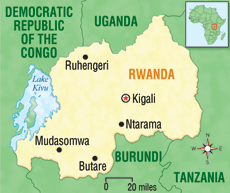
My site is in a tiny village between Kigali and Butare, although it is a completely different universe from either city. This little village is home to a bank, a prison, several schools and a health center that serves a population of over 46,000 people. There are no electrical lines to the village and there is a significant water shortage in the region, so both electricity and water are going to be conveniences I will need to learn to do without over the next two years. While there, my job will entail working with Twubakane (Kinyarwanda for “let’s build together”), which is an organization formed with the Government of Rwanda, USAID, and other NGOs and health care providers, and the health center to do community outreach and education on a variety of subjects: hygiene, nutrition, sanitation, vaccinations, family planning, pre and post-natal care, HIV/AIDS, insecticide-treated nets (ITNs) for malaria, etc.

The story that bests illustrates my time at site begins in the home of the family with whom I was staying as they don’t yet have a house for me in the village. My host dad invited over a couple of his friends who spoke both English and French to help me translate my job description since it was written in French. When we began translating, the lights were still on thanks to the solar panels on the top of their house that provide a limited amount of electricity each day. However, a couple minutes in, the lights went out and all parties involved whipped out flashlights and leaned in to continue working. As I sat there giggling at the immense energy involved in this one task- six adults huddled around a sheet of paper in the dark, both illuminating and translating- one of the guys remarked “this is Africa.” This IS Africa, and as a result everything I do will take longer and be more difficult than I ever anticipated BUT, if I can gain the support and trust of my community, all those goals outlined in my job description just might be possible.

Sunday, March 15, 2009

“Field Trips”: My Experiences at Health Clinics and other Institutions in Rwanda

Over the course of the past couple weeks, our Peace Corps group has been visiting nearby health-related institutions in order to gain further technical information and to get our first glimpse of the facilities available to Rwandans.

Our first visit was, in small groups, one of six nearby health clinics. My group went to a health clinic outside of Butare that offers a comprehensive range of services, from basic consultations and pharmaceutical services, to voluntary counseling and testing (VCT), family planning, and even health education seminars. The health clinic was almost more of a health campus, with separate buildings for the different areas of service. The health system structure in Rwanda works such that, if you have health insurance, you pay a flat fee akin to a co-pay, but this pays for both the consultation and any If you are given a prescription in your consultation, you simply stand in line at the pharmacy window (located in the same building as your consultation) and wait for you medicine. Severe cases are referred further up the system, and in the case of this clinic, are typically taken to the University of Rwanda hospital in Butare, one of the best hospitals in Rwanda. While we were there, we saw a women get in an ambulance holding an IV in one hand. Also while at the health clinic, we saw a mother who had just had a baby that morning. She was lying in one bed and the baby, tiny as could be with huge brown eyes, was wrapped (almost swallowed) in a blanket on the bed next to her. Meanwhile, the father of the baby lurked around outside their room, fetching water and looking as proud as could be. Rwandan hospitals differ from hospitals in the United States in that the hospitals don’t feed their patients- the patient’s family members are required to bring and cook them food. Often, too, the bulk of caring for the non-health essential needs of the patient falls on the family members.
In addition to the health clinic, we visited both an orphanage for OVCs (orphans and vulnerable children) and a women’s center this week. Orphanages are always a tough place to visit, no matter where you are. It seems as though orphanages are the stereotypical place that foreigners visit in Africa, thinking that they can somehow help by holding or playing with the children- perhaps they are helping in the moment, but in the long run, they simply serve to crush the hopes of the children in the orphanage and don’t create any sort of sustainable change for the orphanage. I think orphanages are difficult because ideally all OVCs should be placed with a family, but this just isn’t reality. While Rwandan families do often take in orphans, as we have found within many of our resource families, often those are extended family members instead of just children off the street. At the orphanage we visited yesterday, one of the children was a two week old baby who had just been abandoned on the street and had been brought to the orphanage by the police.

One of the major differences between Rwandan and American children, orphans or non-orphans, is the degree to which they are independent from a young age. In the orphanage, the older children (four or five year olds) were looking after the younger children. A baby who was crawling all over the floor almost crawled out the door and down the stairs several times while we were there, and each time one of the older children ran over, picked the baby up, and set it back down in the middle of the room. As one of the other trainees noted, in America the older children would be just as likely to push the baby down the stairs as to look after it. The orphanage we visited had very little structure for the young children not in school- they had no schedule activities or really any toys to play with (at least none that we saw.) Instead, they just play together and take care of those even younger than them. The one thing that did pleasantly surprise us about the orphanage was that they are truly a family- the nun in charge of the orphanage still counts many of the orphans who have gone on to university as those still living in the orphanage, and the children are never kicked out at a certain age (i.e. 16 or 18), but when they are capable of leaving and living independently.

At the women’s center, we were equally impressed with the training and the comprehensive portfolio of services offered, from psychosocial services to voluntary counseling and testing (VCT). They serve almost 2000 women in the surrounding districts, including a separate back building with private offices and gorgeous views for counseling and a whole host of counseling groups (vulnerable women, widows, sex workers, HIV positive women, etc.) As with many organizations in Rwanda right now, their services are essential part of what differentiates Rwanda from so many other countries in which the AIDS epidemic has flourished, yet they face a downward turn in aid from foreign NGOs, both as a result of the global economic crisis and more demanding problems elsewhere in the world.

Saturday, February 21, 2009

Picture #2


One of the huts for language lessons.

There are how many noun classes?!

Life continues here at the convent. We are currently on our third week, having been inundated with language classes and a sprinkling of technical health and cross-cultural training. The bulk of my time is spent in a small thatched hut, repeating words that contain more a’s, b’s, and u’s than I thought was humanly possible. The language seems at least somewhat straight forward until you learn, as we did today, that there are 16 noun classes, and all associated adjectives must be conjugated accordingly. Rumor has it that Kinyarwanda is one of the hardest languages in the world, second only to Mandarin. Like any language, the words of the language tell you what is important to the culture (like the Inuit and their numerous words for snow.) For example, when a baby is born in Kinyarwanda, one expresses “niyonkwe” (“I wish you to nurse well”) to the mother. This is meant not only for the baby’s health and nutrition, but also for the mother’s sake.

We will continue to spend the greatest proportion of our time focusing on language through the sixth week of pre-service training (PST), when we make our initial visits to our sites, because that will truly be the key to making a difference in the health of our communities, especially in the rural areas where they only speak Kinyarwanda. If you can’t communicate with someone, how are you going to tell them the importance of washing their hands or staying on the ARV regimen prescribed?

Outside of class, I have started visiting our resource families. Fortunately and unfortunately for me, several of my resource family members speak English very well. For the first few visits, this has been great because they have served as an important source of cross-cultural information, but my terrible pronunciation means that I definitely should be spending more time speaking Kinyarwanda with them. On Sunday, the family taught me the traditional Rwandan dance, though they claimed I looked more like I was driving a cow than imitating it. Here the dances are more than just dances, they are a means of communication: women dance as though to mimic a cow and men’s dance moves resemble the fighting of a battle.

I have also been exploring Butare through runs, hikes, and other excursions. Butare consists of one main paved road leading to the university, along which shops, internet cafes, and hotels serve as a backdrop for the hustle and bustle of the town. Just a turn off the paved main road, however, you come face to face with cows and herds of goats. Though we still get stares and the occasional “muzungu” (white person), life has become so routine that I often forget I have only been here a couple of weeks. Amazing how quickly we adapt!

I finally have a Rwandan cell phone, so if you don’t have the number and need it let me know.

Friday, February 6, 2009

Picture #1


The view on our drive from Kigali to Butare.