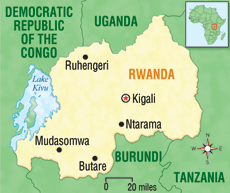
Weddings and madness aren’t typically two subjects one thinks of as going hand in hand, but my first invitation to a wedding also was my first glimpse into mental illness in my village. In Butare, mental illness was more apparent because the presence of rich foreigners allowed for a population to subsist on begging alone. In the more rural areas, communities generally band together to support those who cannot support themselves, removing such persons from the public eye.
In Rwanda, there are typically three “weddings”: the civil ceremony, the church ceremony, and the party. The couple getting married had actually been married (with kids) in the eyes of the Rwandese government for several years, but it takes a lot of money to pull off the party, so they waited until there were able to afford it. The party was held outside their house, between the banana trees and under a tarp that had been erected for the occasion. Underneath these tarps, wooden benches were set up, which we all crowded onto to wait for the bride and groom. After the church ceremony, the family processed back to the house (many of the family members carried gifts of food or drink on their heads as they walked), with the bride and groom bringing up the rear. The bride, as is common of brides in Rwanda, wore a gown that looked as though it came straight out of the 80s, with huge bubble sleeves and all. The party itself, once the bride and groom arrived, consisted of drinking (Fanta, Mutzig, and locally made banana beer), eating (rice, French fries, beans, and meat) and many, many speeches.
Throughout all of this, a mad woman had made herself at home on one of the benches, and insisted on greeting everyone with huge slaps and generally dancing around and causing a ruckus. In America, not only would she have been institutionalized, but even if she had been present at such an event, she would surely have been ignored by the guests. Here, however, she was smiled upon and given a plate of food. The only time she was talked to crossly at all was when she was told “not to bother the muzungus” (aka us.) For the most part, though, so she was simply allowed to be who she was and join in the festivities as she saw fit.
Wednesday, July 8, 2009

Thursday, June 18, 2009
Why can't Americans carry things on their head?
Why, beacause they have cars. Of course.
(These words of wisdom brought to you by the health center staff. Actual update coming soon.)
(These words of wisdom brought to you by the health center staff. Actual update coming soon.)
Tuesday, June 2, 2009


Pentecost
Last Sunday was Pentecost, which is a huge deal in a town where pretty much everything is run by the Catholic Church (not to mention that 56.5% of Rwandans are Roman Catholic according to official numbers.) Since we got here, there has been a wooden frame structure next to the primary school that we have been curious about (it is for farming? for animals?) As we found out on Sunday, it is our village’s version of a stadium. On Sunday, tarps (including one from the UN’s World Food Programme) were laid over the top to protect from sun and rain, and all the church officials and local dignitaries sat under this outdoors enclosure. Down below this pseudo-stage, the church members were barricaded from the front by wooden fences much like an outdoor summer concert would have barricades to keep fans from rushing the stage (more than once, with all the dancing and singing, I felt like I was at a concert). While Pentecostals are known for their ridiculously long church services here, the normal Catholic service doesn’t last any longer than it would in the United States, but Pentecost is different. Sunday’s service stretched on for four hours, which made me thankful that I was on the stage with seating and shade. To combat the sun, a mass of rainbow-striped umbrellas were unfurled by the worshipers, creating quite the colorful spectacle. The stage itself, in addition to boasting seating for the who’s who of our village, included a choir clad in white robes, a group of followers to be confirmed (or at least what I think was confirmation), three acolytes in white and red robes and the alter itself. The entire place was decked out in full Pentecost decorations (white and red everywhere), including yellow flags with a red heart with a sword through it. The alter linens, bible, candles, and communion tools were much like that found in any Catholic church. As one would expect, there is no organ or keyboard here, BUT there were two electric guitars, a traditional drum, and a complete sound system that relayed the words of the priest as well as the choir’s songs to the people. Raised in the Episcopalian church, and given that much of the Episcopalian and Catholic service is the same, many elements and prayers were familiar to me (albeit in a different language), though the singing was much rowdier than I remember from any church service of my past. Markedly different than the traditional church service, though, were the communion and offering, during which huge containers of holy wafers (but no wine) and, in the case of the offering, huge woven baskets, were distributed to the people by over 20 alter helpers. This was mainly out of necessity, as the nuns later told us there were over 1,000 people there.
Thursday, May 21, 2009
Swine Flu in Rwanda
Now that swine flu has safely been downgraded in the world news headlines (BBC radio tells me the top story nowadays is the reported Tamil Tiger defeat in Sri Lanka), I think it is finally safe to post that blog title. In fact, there is no such thing as swine flu in Rwanda. You can all relax now. BUT, despite the fact that no cases have been diagnosed or reported here (or even in our region), Peace Corps sent out Tamiflu to those of us in the Nyamasheke district. According to the messenger, because we are the most remote group, they didn’t feel they could get to us quickly enough in the event of an epidemic (don’t I feel safe) and therefore we get to be responsible for self-medication (with PCMO consultation, of course.) Take-home message: feeling blue? Get yourself some Tamiflu!
I’m kidding, of course. As the responsible pseudo-public health expert I am, I feel obliged to add that improper medicine consumption leads to all sorts of problems (including the emergence of drug-resistant strains.)
I’m kidding, of course. As the responsible pseudo-public health expert I am, I feel obliged to add that improper medicine consumption leads to all sorts of problems (including the emergence of drug-resistant strains.)
Thursday, May 7, 2009

Cyangugu
This past weekend we hitched a ride with our neighbors (the nuns) in the parish car into Cyangugu (also known as Kamembe), the only big town in the region. Along the way we met up with the other two Peace Corps volunteers in our region. Whereas the other big cities I have visited in Rwanda, Butare and Kigali, have both had a decidedly Western influence complete with “supermarkets” stocked with treats like potato chips and bars of chocolate, Cyangugu has nothing of the sort. There is a much more “we are out in the middle of nowhere and know it” feeling to Cyangugu, which is wonderful because it leads you to all sorts of odd little discoveries, but also means that the comforts of home are quite a trek away. As examples of the strange things that occurred while we were in Cyangugu, the first hotel we stopped in (the hotels in Rwanda always seem to have the best restaurants), we encountered a “Big Bass Billy” (you know, one of those mounted plastic fishes that sings) and then at the second hotel we were led through a mini fake forest to a wide cement expanse complete with three swing sets and a gorgeous view of Lake Kivu.
Subscribe to:
Posts (Atom)